
Buy Natural Soothing Salve Online: 2026 Review Guide

Table of Contents
- What to Look for When You Buy Natural Soothing Salve Online
- The Best Botanical Salve for Eczema and Reactive Skin
- Benefits of Calendula for Skin: Why It Anchors Every Formula
- How to Use Herbal Salves for Irritation, Muscle Aches, and Daily Care
- Calendula Salves Reviewed: Which Formula Fits Your Skin
- DIY vs. Store-Bought Salves: Safety, Cost, and Consistency
- Conclusion
- Frequently Asked Questions
Last Updated: September 28, 2026
What to Look for When You Buy Natural Soothing Salve Online
When you buy natural soothing salve online, the label matters more than the marketing. Epifany True, a plant-based skincare brand built around calendula and comfrey, approaches every formula the same way: start with ingredients a compromised skin barrier can actually tolerate, then build outward. A soothing salve is a concentrated, oil-and-wax-based topical that seals moisture into dry, irritated skin while delivering botanical actives; it typically contains no water, which is why it stays stable without preservatives.

Ingredient Sourcing and Label Transparency
A trustworthy label names every ingredient, including the carrier oil, the wax, and any essential oils. Vague terms like "botanical blend" or "natural fragrance" tell you nothing about what is touching your skin. Look for named botanicals such as calendula, comfrey, plantain, or manuka honey, and a clearly stated carrier like sunflower seed oil. If a brand cannot tell you where its herbs come from or how they are processed, that is a signal to keep looking.
The Best Botanical Salve for Eczema and Reactive Skin
The best botanical salve for eczema and reactive skin is a fragrance-free formula built on calendula and comfrey, because both botanicals are traditionally used to calm irritation without adding scent-related triggers. Fragrance, whether synthetic or from essential oils, is one of the most common causes of contact reactions in people with eczema. That does not mean every scented salve is off-limits, but it does mean reactive skin deserves a simpler starting point.
Fragrance-Free vs. Essential Oil Formulas
Fragrance-free formulas skip added scent entirely. The only aroma comes from the herbs and beeswax themselves. Essential oil formulas use plant oils like rose otto, chamomile, lavender, or sandalwood for their calming properties and their scent. For very reactive or treatment-stressed skin, start fragrance-free. For skin that tolerates scent well, a lightly scented salve can be a pleasant part of a daily routine.
Benefits of Calendula for Skin: Why It Anchors Every Formula
The benefits of calendula for skin come down to how its fat-soluble compounds behave once they reach a compromised barrier. Calendula (Calendula officinalis) carries triterpenoid saponins, carotenoids, and flavonoids. The triterpenoids are the ones most often cited in traditional use for calming visible redness; the flavonoids act as antioxidants; the carotenoids support the skin's own repair processes. None of these are water-soluble, which is the single most important fact for anyone buying a salve online: if the calendula was steeped in water and then added as a thin extract, most of those compounds never make it into the jar.
Infused Oil vs. Extract: Why the Label Wording Matters
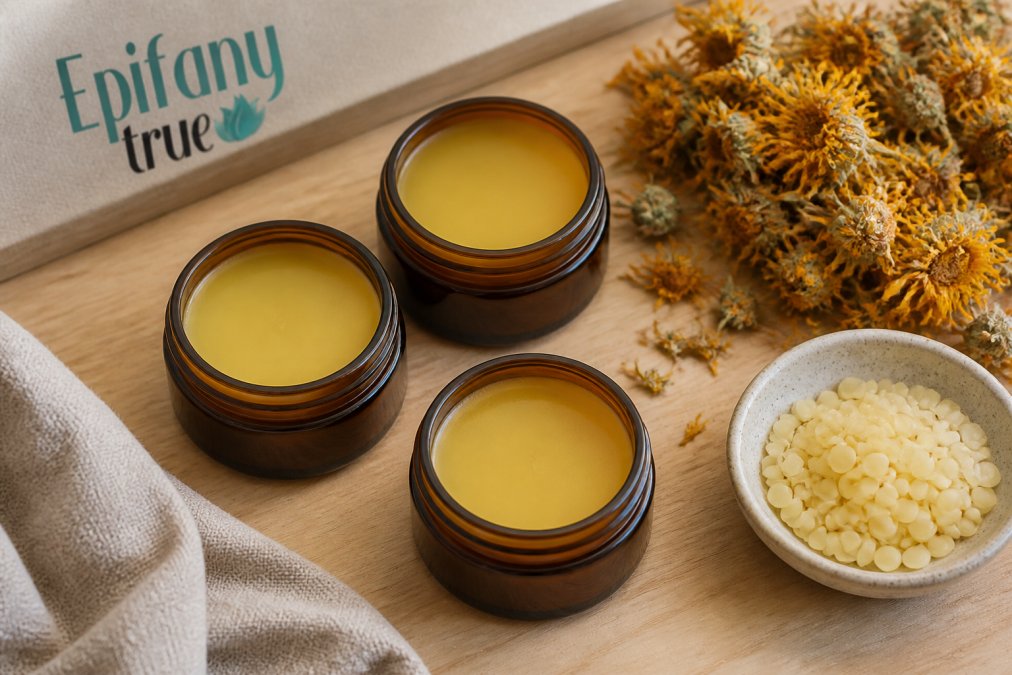
A calendula-infused oil is made by steeping dried flowers in a carrier oil, commonly sunflower seed, jojoba, or olive, for weeks at a controlled temperature. The oil pulls the fat-soluble triterpenoids and carotenoids out of the plant, and the resulting oil takes on a deep gold-to-orange color. That color is a useful tell: a salve made with a genuine calendula infusion usually has a warm, slightly amber tone, while a salve made with a clear extract and a carrier oil stays pale.
How Calendula Works Alongside Wax and Carrier Oil
Calendula is not a single-ingredient story. It works best alongside a protective wax and a nourishing carrier oil, and the ratio between them determines whether the finished salve feels occlusive or breathable.
- Organic beeswax forms a semi-permeable barrier that slows transepidermal water loss. Too much wax and the salve sits on top of the skin; too little and it never sets.
- Calendula-infused sunflower seed oil is high in linoleic acid, which is the fatty acid many reactive and eczema-prone skin types are naturally low in. That is part of why sunflower is a common carrier in barrier-repair formulas rather than a neutral filler.
- Vitamin E (tocopherol) is usually added not as a skin active but as an antioxidant to keep the carrier oil from going rancid, which extends shelf life.
Calendula vs. Other Soothing Botanicals
Calendula is the anchor in most soothing salves, but it is rarely alone. Knowing what the supporting botanicals do helps you match a formula to a specific skin issue rather than buying on scent alone.
| Botanical | Traditional role | Best matched to |
|---|---|---|
| Calendula | Calming, moisture support | Dry, delicate, easily inflamed skin |
| Comfrey | Skin-supporting, traditionally used for minor irritations | Stressed or slow-to-settle skin |
| Plantain | Soothing, traditionally used for insect bites and minor skin upsets | Itchy, reactive patches |
| Chamomile | Calming, gentle | Daily dry or chapped skin |
| Copaiba | Traditionally used for body aches | Muscle and joint areas |
How to Use Herbal Salves for Irritation, Muscle Aches, and Daily Care
Knowing how to use herbal salves for irritation, muscle aches, and daily care comes down to three things: clean skin, a small amount, and consistent timing. A salve is concentrated, so a pea-sized amount covers a large area. Warm it between your fingers first, then press it into the skin rather than rubbing hard.
- Clean and dry the area before applying.
- Warm a small amount between your fingertips.
- Press and smooth the salve into the skin in a thin layer.
- Reapply two to three times daily, or after washing hands and feet.
- For muscle and joint areas, massage in a circular motion until absorbed.
Patch Testing Before First Use
Patch testing is the single most important step before applying any new salve to a large area. Apply a small amount to the inner forearm, cover it, and wait 24 hours. If redness, itching, or burning appears, stop using it. This is especially important for anyone whose skin is already reactive from medical treatment.
Calendula Salves Reviewed: Which Formula Fits Your Skin
Choosing between calendula salves comes down to one question: does your skin need simple, or does it need targeted? Epifany True's line splits along that line, and the price differences are small, so the decision is about function, not budget.
| Salve | Price | Key Ingredients | Best For |
|---|---|---|---|
| Calendula Soothing Salve (Fragrance-Free) | $13.99 | Calendula, beeswax, vitamin E | Fragrance-sensitive, reactive skin |
| Calendula Healing Salve | $14.99 | Calendula, beeswax, rose otto, chamomile | Daily dry, chapped skin care |
| Calendula & Comfrey Herbal Salve (Fragrance-Free) | $15.99 | Calendula, comfrey, plantain, lavender | Stressed skin needing herbal support |
| Calendula & Rose Pain Relief Salve with Copaiba | $14.99 | Calendula, rose, copaiba, chamomile | Muscle aches and joint stiffness |
| Calendula & Sandalwood Pain Relief Salve with Copaiba | $15.99 | Calendula, sandalwood, copaiba, chamomile | Lightly scented everyday muscle relief |
DIY vs. Store-Bought Salves: Safety, Cost, and Consistency
DIY salves look cheaper on paper, but the real difference is consistency, safety, and sourcing transparency, three things a homemade batch cannot easily guarantee and a small-batch maker can document.

The Failure Modes of a Homemade Salve
Most DIY salve problems trace back to one of four issues:
- Inconsistent herb-to-oil ratio. A recipe that says "a handful of dried flowers" produces a different potency every time. A weak infusion gives you a salve that is mostly wax and carrier oil; a too-strong one can be irritating.
- Improper infusion temperature. Steeping herbs too hot degrades heat-sensitive compounds; steeping too cool fails to extract the fat-soluble ones. The sweet spot is a low, steady temperature over several weeks, which most home kitchens cannot hold.
- Wrong wax ratio. Too little beeswax and the salve never sets; too much and it drags on the skin instead of absorbing. This ratio shifts with the carrier oil used, so a recipe that works with olive oil may fail with sunflower.
- Water contamination. A salve is anhydrous by design, which is why it needs no preservative. If any water gets in, from a damp jar, a wet spoon, or incompletely dried herbs, bacteria and mold can grow with nothing to stop them. This is the most serious DIY risk and the hardest to detect.
What Small-Batch Production Actually Controls
A professional small-batch maker runs the same formula every time, which means the jar you buy next month performs like the one you bought last month. That repeatability matters most for reactive skin, where a small shift in an essential oil ratio can trigger a flare. Beyond consistency, small-batch production typically includes:
- Measured infusion. Herbs are weighed, not eyeballed, and steeped at a controlled temperature for a set period.
- Batch testing. Wax-to-oil ratios are tested for set and feel before a full run.
- Anhydrous handling. Jars, tools, and lids are kept dry to protect the water-free environment that keeps the salve stable without preservatives.
- Dating and rotation. Batches are dated so older stock is sold first, which protects the customer from a salve that has already begun to oxidize.
The Sourcing Question DIY Cannot Answer
This is the gap most buying guides skip. When you make a salve at home, you are trusting an herb supplier you probably cannot audit. When you buy from a maker who publishes sourcing, you can ask where the calendula was grown, whether it was tested for pesticides, and how the beeswax was filtered. For anyone with reactive or treatment-stressed skin, that traceability is worth more than the savings from a DIY batch.
For reactive or treatment-stressed skin, consistency and sourcing beat savings. A repeatable small-batch formula removes the guesswork that makes DIY risky, and a maker who can name where the herbs came from removes the sourcing guesswork too.
Conclusion
Finding a salve that works for compromised skin is a process of elimination, and the wrong formula can set recovery back. Epifany True builds fragrance-free and lightly scented options around calendula, comfrey, and copaiba, so there is a starting point for dry, chapped skin, reactive skin, and tired muscles alike. The line includes the Calendula Soothing Salve for the most sensitive routines, the Calendula & Comfrey Herbal Salve for stressed skin, and the Copaiba Pain Relief Salves for body comfort.
Frequently Asked Questions
Are botanical salves safe for sensitive skin?
Botanical salves built on calendula, comfrey, and beeswax are generally well tolerated, but sensitive skin still needs a patch test. Apply a small amount to your inner forearm, wait 24 hours, and check for redness or itching before using it on larger areas. If you are in active medical treatment or your skin is compromised, ask your healthcare team first. Fragrance-free options such as Epifany True's Calendula Soothing Salve skip essential oils entirely, which lowers the chance of a reaction.
What ingredients should I look for in a natural soothing salve?
Start with the base: calendula-infused sunflower seed oil and organic beeswax, which calm irritation and seal in moisture. Comfrey and plantain leaf are worth having if you want extra support for stressed or slow-to-heal skin. Copaiba and chamomile appear in pain-relief formulas. Skip anything with synthetic fragrance if your skin is reactive. Reading the full list before you buy natural soothing salve online matters more than the front label, since 'natural' is not a regulated term in US skincare.
What is the difference between a balm and a salve?
The two terms overlap and brands often use them interchangeably. A salve is typically oil plus wax, sometimes with herbs infused into the oil, and it stays solid at room temperature. A balm usually has a similar base but may include butters or lighter oils for a softer, faster-melting texture. Both work as protectants that slow moisture loss. For very dry or chapped areas, a firmer salve tends to stay put longer than a soft balm.
Is a natural salve worth the cost compared to a basic drugstore lotion?
It depends on what your skin needs. Drugstore lotions are mostly water, so they evaporate and need frequent reapplication. A salve is concentrated oil and beeswax with no water content, so a pea-sized amount covers a large area and lasts through handwashing. Epifany True's salves run $13.99 to $15.99 for a 2oz jar, and bundles bring the per-jar cost down further. For chronic dryness or eczema-prone patches, the concentrated format often works out cheaper per use.
Can I use the same salve on my face, hands, and a baby's skin?
A fragrance-free formula is the safest single jar for shared use. Epifany True's Calendula & Comfrey Herbal Salve contains no added fragrance or essential oils, so it suits children's skin and adults with reactive faces. The original Calendula Healing Salve includes rose otto and chamomile essential oils, which most adults tolerate well but which a baby or a very reactive face may not. Keep one unscented jar for family use and a second for your own routine if you prefer a scented finish.
Next article


