
Why Botanical Skincare Works Better for Rashes

Table of Contents
- Why Botanical Skincare Is Better for Rashes
- How Plant-Based Ingredients Address Skin Irritation
- Herbs for Skin Rashes: Calendula, Comfrey, and Beyond
- Botanical Skincare for Sensitive Skin: What Makes It Different
- How to Patch Test Skincare Products Safely
- Calendula Salve for Irritated Skin: A Gentle Solution
- When to Seek Medical Care for a Rash
- Building a Botanical Skincare Routine for Rash-Prone Skin
- Frequently Asked Questions
Last Updated: October 18, 2026
Why Botanical Skincare Is Better for Rashes
When skin develops a rash and botanical skincare rashes become a concern, the impulse is often to strip it bare with harsh actives. Botanical skincare supports the skin barrier rather than disrupting it.
Rashes stem from inflammation, barrier compromise, or both. Conventional treatments often target only the symptom, reducing visible redness without addressing the irritation that keeps skin reactive. Botanical ingredients address inflammation at its source while nourishing the barrier.
Reactive skin cannot tolerate heavy exfoliation, active-laden serums, or fragrance. Botanical formulations for sensitive skin eliminate these irritants, replacing them with ingredients traditionally used to soothe compromised tissue.
How Plant-Based Ingredients Address Skin Irritation
Plant-derived skincare works through two mechanisms: reducing inflammation and restoring barrier function. Unlike synthetic actives that force change through chemical intensity, botanicals work with the skin's natural healing processes.
Antioxidants and Anti-Inflammatory Compounds
Many plant extracts contain phytochemicals that combat oxidative stress and calm inflammatory response. Calendula is rich in flavonoids and carotenoids, associated with reducing redness and supporting tissue repair. Comfrey contains allantoin, traditionally used to accelerate cell regeneration and soothe irritated areas.
Calendula has a long history of use as a gentle care solution for dry, sensitive, and irritated skin. When skin is inflamed, these anti-inflammatory botanicals can help soothe discomfort while the barrier stabilizes, working gently over time to avoid triggering additional irritation during healing.
Supporting the Skin Barrier
The skin barrier, the outermost layer of dead skin cells and lipids, is the body's primary defense against irritants and moisture loss. A compromised barrier lets irritants in and hydration out, perpetuating the rash cycle. Botanical oils and plant-derived lipids support repair by providing the fats skin needs to rebuild.
Sunflower seed oil contains linoleic acid and other lipids that closely resemble the skin's own profile; applied topically, they integrate into the barrier, strengthening moisture retention and irritant exclusion. Beeswax creates an occlusive layer that locks hydration in.

Herbs for Skin Rashes: Calendula, Comfrey, and Beyond
Most guides list soothing herbs and stop there. That is not enough, because a botanical that calms one rash can aggravate another. The useful question is "which herb, for which rash, at what evidence level, and with what known risk."
Evidence quality by ingredient
Evidence for botanicals falls into three tiers.
- Best-supported for soothing irritated skin: colloidal oatmeal is the clearest example, it is recognized in over-the-counter skin protectant monograph labeling for temporary relief of minor skin irritation and itching. Calendula has a reasonable base of small clinical and laboratory work on wound healing and irritation, but the trials are generally small (pubmed.ncbi.nlm.nih.gov). Chamomile has modest supportive data for minor irritation, with the caveat that it is a known allergen for some people (especially those sensitive to ragweed-family plants).
- Preliminary or laboratory-stage: comfrey (allantoin), plantain, and many flavonoid-rich extracts. Plausible mechanisms, limited human trial data for rash specifically.
- Traditional use only: most "centuries of use" claims. Tradition is a starting point for safety intuition, not proof of efficacy.
Ingredient-specific safety and contraindications
- Comfrey: contains pyrrolizidine alkaloids in the raw plant; topical cosmetic use of refined extracts is common, but comfrey is not appropriate on broken, oozing, or open skin, and should not be used on large areas for prolonged periods. It is a poor choice for a rash you have scratched raw.
- Essential oils (lavender, tea tree, and others): fragrance and essential oils are among the most common causes of allergic contact dermatitis. Lavender oil oxidizes on exposure to air and light, and oxidized lavender is more likely to sensitize. "Natural fragrance" is still fragrance.
- Chamomile, calendula, and other daisy-family plants: cross-reactivity is possible in people with ragweed, chrysanthemum, or other Asteraceae allergies.
- Nut and seed oils: almond, apricot kernel, and similar oils can be a problem for people with tree-nut allergy depending on processing; patch test first.
- Beeswax and propolis: generally well tolerated, but propolis is a recognized contact allergen.
- Dry, scaly, eczema-type patches: barrier-repairing lipids and occlusives matter more than any single herb. Calendula-infused sunflower oil, beeswax-based salves, and fragrance-free balms fit here.
- Itchy but intact skin: colloidal oatmeal and chamomile-containing products have the most supportive labeling and data.
- Rough, thickened, psoriasis-type plaques: emollients help with scaling and comfort, but cosmetic botanicals do not treat the underlying condition, that needs a clinician.
- Contact dermatitis (from a product, metal, or plant): the fix is removing the trigger, not adding another botanical on top.
- Fungal rashes (ring-shaped, spreading, itchy): occlusive oils and salves can make fungal rashes worse by trapping moisture. This is a case where "more moisture" is the wrong instinct.
What this means for product selection
The most defensible botanical products for rash-prone skin are simple, fragrance-free, and built on well-tolerated lipids. Epifany True's Calendula Soothing Salve, calendula-infused sunflower seed oil, organic beeswax, and vitamin E, fits that profile: a short ingredient list, no added fragrance, and a barrier-supporting base. For facial rashes where a heavy salve is too much, the Prickly Pear & Camellia Face Oil Serum delivers lightweight plant lipids and antioxidants without occluding.

None of these is a treatment for a diagnosed skin condition. They are barrier-supportive cosmetics, and are not a substitute for knowing what the rash actually is.
Botanical Skincare for Sensitive Skin: What Makes It Different
The standard line, conventional products remove irritants, botanical products add soothing compounds, is true but incomplete, and it implies botanicals are automatically safer. They are not. Plant extracts are chemically complex mixtures, and complexity is exactly what sensitive skin reacts to.
Botanicals are not automatically safer
Allergic contact dermatitis from botanical ingredients is well documented. Essential oils, fragrance components, and certain plant extracts are among the more common culprits in patch-test clinics, and "fragrance-free" does not always mean free of plant-derived scent compounds. A plant ingredient can be both soothing and sensitizing depending on the person, the concentration, and how oxidized it is. The honest framing is not "botanical beats synthetic" but "the right botanical, formulated simply and fragrance-free, can support a compromised barrier, and the wrong one can trigger a new rash."
What actually separates a good sensitive-skin formula
Judge a product on these, regardless of whether the ingredients are plant-derived:
- Short ingredient list. Fewer ingredients means fewer chances for a reaction and an easier time identifying a culprit.
- No added fragrance and no essential oils in products meant for active rashes. This is the single biggest lever for reactive skin.
- Well-tolerated lipid base. Sunflower seed oil, for example, is high in linoleic acid and closely resembles the skin's own lipid profile, a reason it shows up in barrier-focused formulas.
- No drying alcohols, no exfoliating acids, no retinoids in a product positioned for irritated skin.
- Clear labeling. "Fragrance-free" is more useful than "unscented," which can still contain masking fragrance.
Where botanical formulas genuinely earn their place
For skin that is dry, tight, and barrier-compromised, plant oils and waxes provide lipids the barrier can use, and occlusives reduce water loss, a real, mechanistic benefit. Epifany True's Calendula Soothing Salve is built for exactly this: fragrance-free, short list, occlusive enough for extra-dry patches. The Scalp Soothing Oil is the relevant pick when irritation is on the scalp, where heavier salves are impractical. The Prickly Pear & Camellia Face Oil Serum suits facial skin that needs lightweight barrier support without occlusion.
Where they do not
Botanical cosmetics are not a substitute for prescription care. They are not the right first move on broken, weeping, or infected-looking skin. And if a rash appeared after starting a new botanical product, the botanical is the suspect, not the solution.
The differentiator is not plant versus synthetic. It is simple, fragrance-free, barrier-supportive formulation versus complex, fragranced, active-heavy formulation. Botanicals can sit on either side of that line.
How to Patch Test Skincare Products Safely
Even botanical products can trigger reactions in sensitized skin. Patch testing before full application prevents wasting product and avoids spreading a reaction across larger areas.
Step 2: Apply a small amount. Use roughly the size of a pea. More product doesn't provide better information; it only increases reaction risk.
Step 3: Wait 24-48 hours. Watch for redness, itching, burning, or swelling. Some reactions appear immediately; others develop over hours.
Step 5: Introduce one product at a time. If building a new routine, add products one week apart.
For compromised skin, a 48-hour patch test prevents a full-face reaction that sets back healing by weeks.
Calendula Salve for Irritated Skin: A Gentle Solution
When skin needs comfort, a concentrated botanical salve can deliver a moisture-sealing layer.
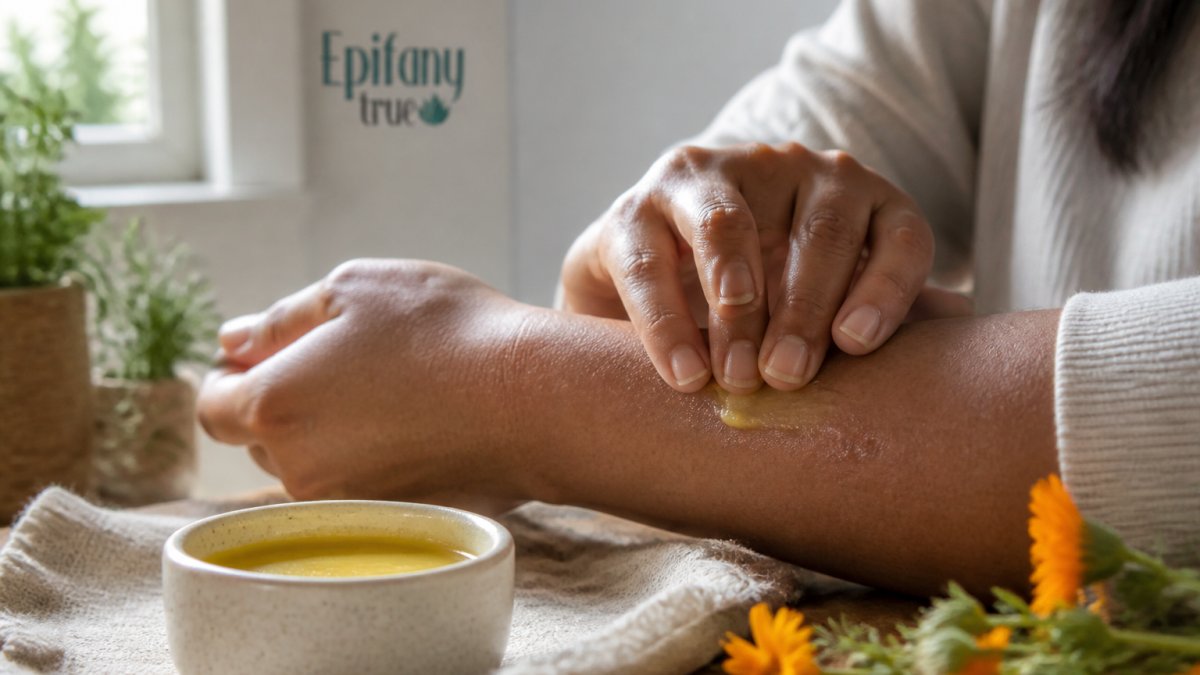
Fragrance-free calendula salves are ideal for skin too reactive for essential oils, providing concentrated botanical support without fragrance-related irritation. For dry, sensitive-feeling skin, a simple fragrance-free formulation can provide comfort.
Apply a thin layer to the affected area and allow it to absorb. Because salves are occlusive, a little goes a long way.
Epifany True's Calendula Soothing Salve combines calendula-infused sunflower seed oil with organic beeswax and vitamin E, designed for fragrance-sensitive routines and extra-dry areas. The short ingredient list means fewer potential irritants for reactive skin.

When to Seek Medical Care for a Rash
Botanical skincare soothes mild to moderate irritation, but some rashes require medical evaluation and cannot be managed with topical products alone.
Seek medical care if:
- The rash appears suddenly and spreads rapidly across large skin areas
- The rash is accompanied by fever, chills, or systemic symptoms
- The rash blisters, oozes, or shows signs of infection (warmth, pus, increasing redness despite treatment)
- The rash causes severe pain or burning that doesn't improve with topical care
- The rash persists beyond two weeks despite consistent botanical skincare use
- The rash appears as a reaction to a new medication or medical treatment (notify the prescribing physician immediately)
- The rash is on the face and near the eyes, or covers more than 30% of the body
Botanical skincare is a supportive tool, not a substitute for medical diagnosis. If a rash's cause is unclear or symptoms worsen, professional evaluation is necessary. Providers can distinguish between contact dermatitis, eczema, psoriasis, fungal infection, and other conditions requiring different approaches.
For people undergoing chemotherapy or radiation, discuss new skincare products with the treatment team first. Some botanical ingredients may interact with specific treatments or be contraindicated during certain phases of care.
Building a Botanical Skincare Routine for Rash-Prone Skin
A rash-prone routine prioritizes simplicity, barrier support, and irritant avoidance, fewer products touching reactive skin, each one earning its place.
Step 1: Cleanse gently. Use lukewarm water and a fragrance-free, non-stripping cleanser. Avoid hot water, which disrupts the barrier.
Step 4: Avoid active ingredients during the acute phase. Retinoids, acids, vitamin C, and other actives can irritate compromised skin.
Step 5: Use sunscreen if going outdoors. A fragrance-free mineral sunscreen protects healing skin from UV stress.
This routine uses just three to four products, minimizing the irritant exposure that often perpetuates rashes.
Rashes test the limits of conventional skincare because standard products often contain irritants that worsen the condition.
Frequently Asked Questions
What herbs can help with skin rashes?
Calendula, comfrey, chamomile, plantain, and lavender have a long history of use in botanical skincare. Calendula is rich in flavonoids and carotenoids. Comfrey contains allantoin. Chamomile and lavender are known for their calming properties. Plantain has been traditionally used to soothe various skin conditions. These botanicals are often found in formulations designed for sensitive skin.
How do you patch test a new skincare product?
Apply a small amount of the product to a discreet area like your inner arm or behind your ear. Wait 24-48 hours and observe for redness, itching, burning, or swelling. If your skin is already compromised or you're undergoing medical treatment, start with an even smaller amount and consult your healthcare provider first. Patch testing is especially important for botanical products, as plant-derived compounds can trigger sensitivity in reactive skin.
Can botanical skincare cause an allergic reaction?
Yes. Botanical ingredients are not automatically safer than synthetic ones. Some people react to specific plant compounds, essential oils, or fragrance components. Those with known plant allergies or very reactive skin face higher risk. Fragrance-free botanical formulations reduce this risk compared to products with added essential oils. Always patch test before full application, and if you experience burning, swelling, or severe itching, discontinue use and consult a dermatologist.
When should you see a doctor about a rash?
Seek medical care if a rash spreads rapidly, blisters, oozes, or causes severe pain; if it's accompanied by fever or systemic symptoms; if it worsens despite home care; or if it lasts longer than two weeks. If you're undergoing chemotherapy or radiation, consult your oncology team before using any new topical product. A healthcare provider can diagnose the underlying cause and recommend appropriate treatment alongside botanical care.
Previous article


