
Fragrance Free Skincare for Babies: 2026 Guide

Table of Contents
- Quick Comparison: Fragrance-Free Baby Skincare Options
- How to Identify Synthetic Fragrances in Baby Products
- What to Look For in Fragrance Free Skincare for Babies
- Natural Ingredients for Baby Eczema
- Budget vs. Premium: What You Get for the Price
- Seasonal Skincare Adjustments for Baby Skin
- Conclusion: Building a Gentle Routine That Lasts
- Frequently Asked Questions
Last Updated: September 20, 2026
Quick Comparison: Fragrance-Free Baby Skincare Options
Fragrance free skincare for babies is a category where the label matters more than the marketing. This guide from Epifany True breaks down what to look for, what to avoid, and which gentle formulas earn a place in a nursery.
Product |
Price |
Key Ingredients |
Best For |
|---|---|---|---|
$13.99 |
Calendula, sunflower oil, beeswax, vitamin E |
Fragrance-sensitive daily moisture |
|
Calendula & Comfrey Herbal Salve 2oz |
$15.99 |
Calendula, comfrey, plantain, lavender |
Dry, irritated, or stressed skin |
100% Natural Calendula Oil 2oz |
$14.99 |
Calendula-infused sunflower oil |
Diaper rash, body massage |
Calendula Rose Lip Balm |
$8.00 |
Shea butter, cocoa butter, calendula |
Chapped lips on older children |
How to Identify Synthetic Fragrances in Baby Products
The fastest way to spot hidden fragrance is to read the ingredient list past the first five items. Fragrance rarely appears at the top, but it is almost always there if the product smells like anything at all.

Label Terms That Hide Fragrance
A single word on a label can represent dozens of undisclosed chemicals. The following terms all signal added scent:
- Fragrance or parfum: an umbrella term that can contain any number of scent compounds
- Essential oil blends: natural, but still a common irritant for babies
- Masking fragrance: added to cover the smell of other ingredients
- Aroma or natural aroma: not regulated the same way as "fragrance"
- Linalool, limonene, citronellol: individual fragrance components often listed separately
Unscented vs. Fragrance-Free: A Label Trap
These two claims are not interchangeable, and the difference matters for a baby's skin.
- Fragrance-free means no fragrance has been added to the formula. This is the claim to look for.
- Unscented means the product has no noticeable smell, but it may contain masking fragrance added to neutralize the scent of other ingredients.
- Naturally scented means essential oils or plant extracts were used for scent. Natural does not mean non-irritating; lavender, citrus, and peppermint oils are common triggers.
The Patch Test That Takes Five Minutes
A patch test is the simplest way to check whether a product will irritate a baby's skin before it goes on the whole body. Apply a small amount to the inner forearm, cover it with a bandage, and wait 24 hours. If redness, bumps, or swelling appear, stop using the product.
A Step-by-Step Patch Test Guide
Most parents skip patch testing because they are not sure how to do it. Here is a repeatable method:
- Pick a clear patch of skin. The inner forearm or the area behind the knee works well. Avoid broken or already-irritated skin.
- Apply a pea-sized amount. Use the same amount you would use on the face.
- Cover it. A bandage or a small piece of gauze taped in place keeps the product from rubbing off.
- Wait 24 hours. Do not wash the area. Note any change in color, texture, or temperature.
- Check at 48 hours. Some reactions are delayed. A second look catches them.
- Introduce one product at a time. If you start three new products at once, you will not know which one caused a reaction.
What to Look For in Fragrance Free Skincare for Babies
The best fragrance-free baby products share four traits: a short ingredient list, no added scent, a moisturizing base, and a formula matched to the baby's skin condition. Length matters. Fewer ingredients mean fewer chances for a reaction.
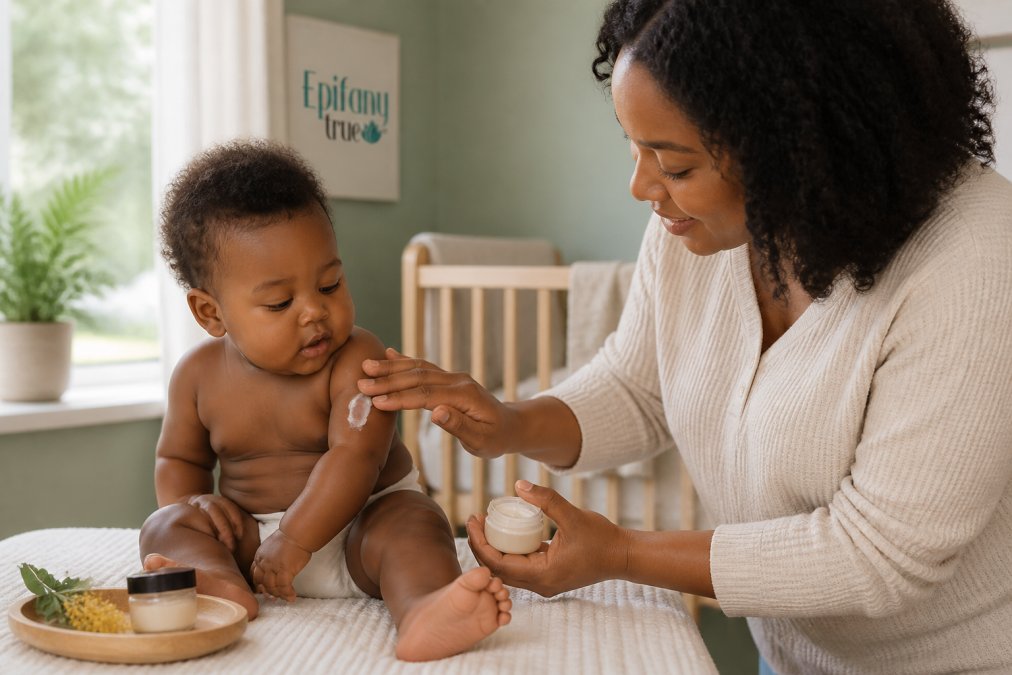
Look for these categories of ingredients:
- Emollients like sunflower oil and shea butter soften and smooth dry patches
- Occlusives like beeswax seal in moisture and support the skin barrier
- Humectants like glycerin draw water into the skin
- Botanicals like calendula and comfrey calm irritation and support recovery
Natural Ingredients for Baby Eczema
Eczema-prone skin has a weaker barrier, which means it loses moisture faster and reacts to more ingredients. Fragrance-free formulas matter most here, because added scent is one of the most common flare triggers. The goal of a daily routine is not to cure eczema but to keep the barrier calm and hydrated enough that flares are less frequent and less severe.
Ingredients That Support Eczema-Prone Skin
Calendula and comfrey are the two botanicals most often recommended for eczema-prone baby skin, and both have long histories in traditional skincare. Calendula calms redness and supports the skin barrier. Comfrey is traditionally used to comfort areas of dryness and minor irritation.
Other ingredients worth knowing:
- Colloidal oatmeal: soothes itching and is widely used in eczema care. It is one of the few ingredients with a long track record in pediatric eczema routines.
- Ceramides: lipids that help rebuild the skin barrier. Barrier repair is the core of long-term eczema management.
- Shea butter: rich emollient that softens rough skin.
- Jojoba oil: lightweight and close to the skin's own oils.
- Petrolatum: a classic occlusive that seals in moisture. It is not plant-based, but it is one of the most reliable barrier ingredients for stubborn patches.
Calendula and Comfrey: What the Research Shows
Calendula has been studied for its calming effect on irritated skin. Comfrey is valued for supporting skin that is slow to recover. Together, they form the base of many gentle salves.
A Daily Eczema Routine That Works
Eczema care is less about any single product and more about consistency. A routine for eczema care looks like this:
- Bathe briefly and lukewarm. Five to ten minutes is enough. Long, hot baths strip the barrier.
- Use a fragrance-free cleanser. Skip bubble baths and heavily scented washes.
- Pat, do not rub. Leave the skin slightly damp.
- Moisturize within three minutes. This is the single highest-impact step. Apply a thick, fragrance-free cream or salve while the skin is still damp.
- Moisturize at least twice daily. More often during flares.
- Dress in soft, breathable fabrics. Cotton is a safe default. Wool and rough synthetics can trigger itching.
Flare Triggers to Watch
Most flares trace back to a small set of triggers. Common ones include:
- Added fragrance, essential oils, and masking fragrance
- Harsh soaps, detergents, and fabric softeners
- Dry indoor air, especially in winter
- Saliva and drool sitting on the chin and cheeks
- Overheating and sweating
- Rough seams and tags on clothing
When to See a Pediatrician
A fragrance-free routine handles mild, dry, itchy patches well. It is not a substitute for medical care. Book a visit if you see:
- Yellow or honey-colored crusting, which can signal infection
- Skin that is warm, swollen, or oozing
- A baby who is not sleeping or feeding well because of itching
- Patches that spread quickly or do not respond to consistent moisturizing
Budget vs. Premium: What You Get for the Price
Price in baby skincare rarely tracks quality as closely as parents expect. A $13.99 salve and other creams may share most of the same base ingredients. The difference usually comes down to concentration, sourcing, and how many extras are added.
What drives cost up in premium products:
- Certified organic sourcing across every ingredient
- Small-batch production with tighter quality control
- Fancier packaging and marketing
Seasonal Skincare Adjustments for Baby Skin
Winter air and indoor heating strip moisture from a baby's skin, while summer heat and chlorine can trigger irritation. Adjusting the routine by season prevents most flare-ups before they start.
Cold-weather adjustments:
- Switch to a thicker salve or balm for extra-dry areas
- Apply moisturizer twice daily instead of once
- Run a humidifier in the nursery
- Keep bathwater lukewarm, not hot
Warm-weather adjustments:
- Use a lighter oil or lotion during the day
- Rinse off chlorine and sunscreen after swimming
- Keep the baby in breathable cotton
- Apply a barrier salve before diaper changes to reduce friction
Conclusion: Building a Gentle Routine That Lasts
The most reliable approach to fragrance free skincare for babies is a short routine with a few trusted products. Cleanse gently, moisturize while the skin is damp, and patch test anything new.
Frequently Asked Questions
Is there a fragrance-free baby moisturizer available?
Yes. Fragrance-free moisturizers for babies are widely available, but formulas vary in what they leave out. Some remove synthetic fragrance while keeping essential oils, which can still irritate sensitive skin. The safest options list no added fragrance and no essential oils at all. Epifany True's Calendula Soothing Salve 2oz Fragrance-Free uses calendula-infused organic sunflower oil, organic beeswax, and vitamin E with no added scent, making it a straightforward choice for parents who want a short ingredient list.
How can I tell if a baby product is truly fragrance-free?
Read the full ingredient list, not just the front label. Terms like parfum, fragrance, and aroma signal added scent. Essential oils such as lavender, citrus, or peppermint also count as fragrance even when they are plant-derived. A truly fragrance-free product will not list any of these. If the label says unscented but the ingredients include masking fragrance, the product still contains scent compounds. When in doubt, choose products with the fewest ingredients.
What ingredients should I avoid in baby skincare products?
Avoid synthetic fragrance (parfum), essential oils, parabens, sulfates, dyes, and petroleum-based ingredients when possible. Some babies react to preservatives like methylisothiazolinone. For eczema-prone or sensitive skin, stick to short ingredient lists built around emollients and occlusives. Calendula, comfrey, and colloidal oatmeal are commonly used botanicals for calming dry, irritated patches. Always patch test a small area before applying a new product to larger areas.
How do I treat dry patches on my baby's skin without using scented lotions?
Apply a fragrance-free, thick emollient immediately after a lukewarm bath while skin is still damp. This locks in hydration and supports barrier repair. For stubborn dry patches, a concentrated salve with occlusive ingredients like beeswax can seal moisture overnight. Epifany True's Calendula Comfrey Herbal Salve 2oz Fragrance-Free combines calendula, comfrey, and plantain in a beeswax base. If patches are cracked, oozing, or spreading, see a pediatrician before trying new products.
Is organic always better for baby skin?
Organic certification tells you how ingredients were grown, not whether they will irritate your baby's skin. A certified organic product can still contain essential oils that trigger reactions. What matters more is whether the formula is fragrance-free, dye-free, and free of known irritants. Organic calendula and sunflower oil are gentle choices, but the full formula matters more than any single certification. Look for short ingredient lists and patch test every new product.
Previous article

Next article


