
Is Sea Buckthorn Good for Your Skin?

Last Updated: November 5, 2026
Quick Summary
Sea buckthorn is a shrub whose berries, seeds and oils contain vitamins, fatty acids and plant compounds, and it is used mainly in skin care as an oil in balms and serums. Its skin benefits are mostly traditional use and composition-based reasoning, so results depend on the specific product.
- Sea buckthorn skin products usually use the oil as one ingredient alongside other botanicals.
- Check whether the label names the seed, pulp, or whole-berry oil, since each feels and performs differently.
- Skin benefits are plausible but not firmly established by clinical research.
- Patch test before use, especially if your skin is reactive or compromised.
- Anyone on blood-thinning medication should consult a healthcare professional before using sea buckthorn juice or supplements.
Table of Contents
- What Sea Buckthorn Is and Where It Grows
- Nutritional Composition: Vitamins, Fatty Acids and Plant Compounds
- Sea Buckthorn Benefits: What the Research Supports
- Sea Buckthorn for Skin: Oil, Balm and Serum Uses
- Sea Buckthorn Oil vs. Juice: Which Form Fits Your Needs
- Sea Buckthorn Oil: Seed Oil, Pulp Oil and Ingredient Labels
- Who Should Be Cautious and Choosing Your Next Sea Buckthorn Product
- Frequently Asked Questions
What Sea Buckthorn Is and Where It Grows
Sea buckthorn (Hippophae rhamnoides) is a deciduous, suckering shrub with silvery leaves and thorny branches that produces small, bright orange berries. It is a pioneer species, meaning it colonizes harsh, sandy, and nutrient-poor ground where many other plants struggle.
The berries, seeds, and pulp of the plant are the source of the products most people encounter today, including frozen or dried berries, juice, tea, and oils. Each form draws on different parts of the plant, which is one reason product labels matter. A seed oil and a pulp oil from the same shrub can differ considerably in their fatty acid profile.
Nutritional Composition: Vitamins, Fatty Acids and Plant Compounds
Sea buckthorn berries contain a wide mix of plant compounds. Reviews in the scientific literature describe the leaves, fruits, and shoots as containing biologically active substances, including vitamins, fatty acids, carotenoids, and flavonoids. The exact profile varies by plant variety, growing conditions, and how the product is processed.
Among the fatty acids, the berry pulp and seed are commonly discussed for their omega-7 and omega-3 content, while the seed oil is often noted for omega-6 and omega-9. Vitamin C and vitamin E are also frequently cited components. Because these figures shift between sources, treat any single number with caution and check the specific product's analysis before relying on it.
Composition research is also active.
Sea Buckthorn Benefits: What the Research Supports
Sea buckthorn is often promoted for a long list of benefits, so it helps to separate what has been studied from what is simply claimed.
Evidence Grading by Health Claim
Not all sea buckthorn claims carry the same weight. The table below sorts common claims by the strength of the evidence currently available to this article.
| Claim | Evidence level | What it means for readers |
|---|---|---|
| Contains vitamins, fatty acids, and plant compounds | Well documented in composition reviews | The composition is real, but amounts vary by product |
| Mood-related outcomes in one placebo-controlled juice study | Early, limited | Encouraging, but a single study does not prove an effect |
| Digestive and cardiovascular uses | Proposed uses in consumer summaries | Not established as treatments or preventives |
| Skin benefits | Mostly traditional use and composition-based reasoning | Plausible for skin care, but check the specific product |
Sea Buckthorn for Skin: Oil, Balm and Serum Uses
Sea buckthorn appears in skin care mainly as an oil, and it is usually one ingredient among several.
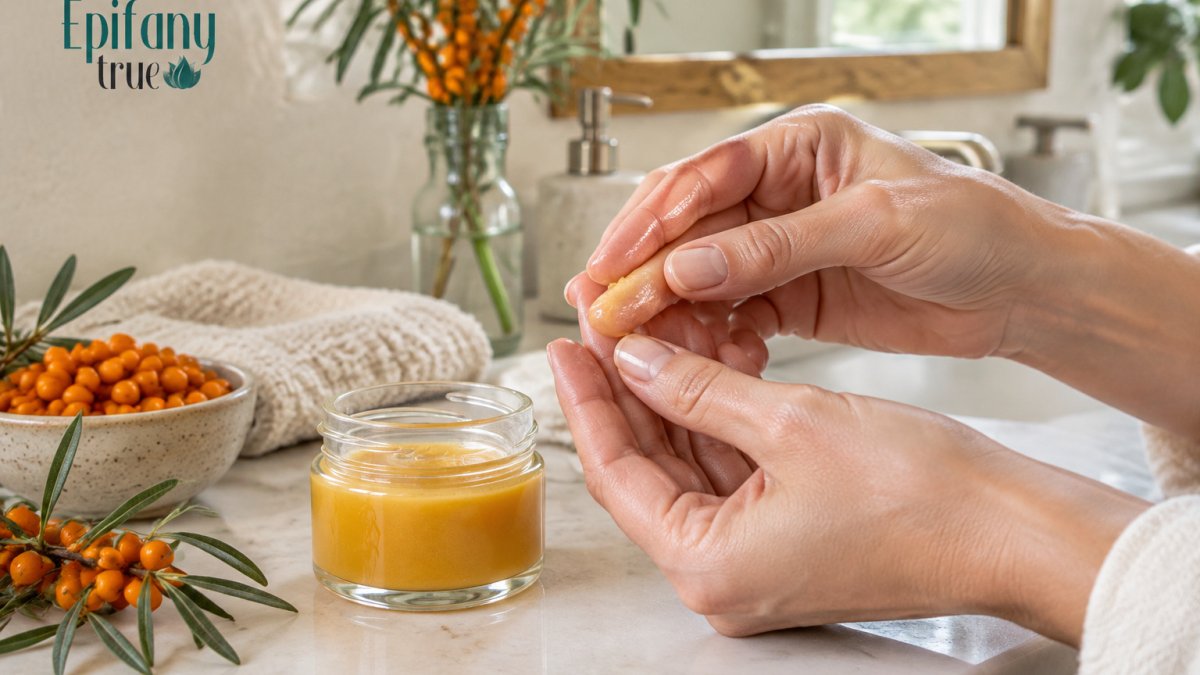
The Calendula Overnight Face Balm with Sea Buckthorn (https://epifanytrue.com/products/calendula-overnight-face-balm-with-sea-buckthorn-1oz) is one way to use the ingredient at night. Priced at $19.00, it combines golden sea buckthorn fruit oil with certified organic calendula, plantain leaf, jojoba oil, yellow beeswax, and vitamin E in a fragrance-free, waterless balm. Its listing describes it as made for nights when facial skin feels exceptionally dry.

Applied to facial skin, a balm is a richer choice than a light serum. Users with reactive skin should patch test first. For people who prefer a lighter product, the Prickly Pear & Camellia Face Oil Serum (https://epifanytrue.com/products/organic-prickly-pear-and-camellia-serum-30ml) offers a different texture for daytime or layered use, and the Scalp Soothing Oil (https://epifanytrue.com/products/100-pure-natural-scalp-soothing-oil-4oz) addresses the scalp rather than the face.


Sensitive skin needs particular care. Shoppers who want to start with a gentle base can explore the Sensitive Face Care collection.
Sea Buckthorn Oil vs. Juice: Which Form Fits Your Needs
Oil and juice are not interchangeable. The oil is used topically or as an ingredient in balms and serums, while juice is consumed. Choosing between them depends on the purpose, and the two forms should not be assumed to deliver the same effects.
Oil is the form most often used on the skin. For a fuller guide to calendula and botanical oils for dry, compromised skin, see Calendula Oil for Dry Compromised Skin: A Complete Guide. Product labels and manufacturer instructions are the most reliable guide to use.
Anyone considering the juice should keep in mind that a 2025 case report described daily consumption of 100 grams of sea buckthorn syrup for six months as associated with a harmless but noticeable yellow discoloration of the skin. It is a single report, but it illustrates that heavy, prolonged intake can have visible effects.
Sea Buckthorn Oil: Seed Oil, Pulp Oil and Ingredient Labels
The term "sea buckthorn oil" covers at least three distinct products, and they are not interchangeable. For more on gentle botanical oils suited to sensitive skin, read Gentle Botanical Oils for Sensitive Skin: A Guide. Knowing which one a label refers to tells you more about how it will behave than the words "sea buckthorn" on the front of the bottle.
Seed oil vs. pulp oil vs. whole-berry oil
- Seed oil is pressed from the seeds. It is typically lighter in color and thinner in texture. It spreads easily.
- Pulp oil (also called fruit oil) comes from the fleshy berry. It is deep orange to red and thicker.
- Whole-berry oil combines seed and pulp, so it sits between the two in color and texture.
A product that lists "sea buckthorn oil" without naming the part leaves you guessing which of these you are getting. That matters because the choice changes how the product feels on skin and what it is best suited for.
How to read the label
When comparing products, check four things:
- Plant part. Seed, pulp/fruit, or whole berry. The more specific, the better.
- Extraction method. Check whether the oil is cold-pressed or refined.
- Position in the ingredient list. Ingredients are listed by weight, so a sea buckthorn oil near the end is a minor component, not the headline.
- Carrier and supporting ingredients. A balm or serum is a blend; the sea buckthorn is one player among several, and the carrier oil (jojoba, camellia, prickly pear) shapes the texture as much as the sea buckthorn does.
The Calendula Overnight Face Balm with Sea Buckthorn (https://epifanytrue.com/products/calendula-overnight-face-balm-with-sea-buckthorn-1oz), for example, lists golden sea buckthorn fruit oil cold-pressed from the whole berry and left unrefined, paired with certified organic calendula, plantain leaf, jojoba oil, yellow beeswax, and vitamin E.
Matching the form to the use
- Facial serum or daytime layer: a seed-forward or whole-berry oil in a light carrier, like the Prickly Pear & Camellia Face Oil Serum (https://epifanytrue.com/products/organic-prickly-pear-and-camellia-serum-30ml), suits skin that wants a thinner texture.
- Night balm: a balm with a beeswax base, like the Calendula Overnight Face Balm, suits overnight use.
- Scalp: a targeted formula such as the Scalp Soothing Oil (https://epifanytrue.com/products/100-pure-natural-scalp-soothing-oil-4oz) is built for the scalp rather than the face, and the two should not be swapped casually.
- Body: a lightweight body oil such as the Apricot & Camellia Satin Body Oil (https://epifanytrue.com/products/apricot-camellia-satin-body-oil) is the after-bath option, and it is a different product from the face serum even when the carrier oils overlap.
Who Should Be Cautious and Choosing Your Next Sea Buckthorn Product
Sea buckthorn is used in food and cosmetics. Anyone with specific health conditions or concerns should check with a healthcare professional before use (Dietary and Herbal Supplements).
Medication and bleeding considerations
- Anticoagulants and antiplatelet drugs such as warfarin, apixaban, rivaroxaban, clopidogrel, and daily aspirin. The theoretical concern is additive bleeding risk, so anyone on these medications should talk to their prescriber before adding sea buckthorn juice, supplements, or concentrated oil.
- Surgery and dental procedures. Because of the same clotting concern, a common pattern is to stop sea buckthorn supplements about two weeks before a scheduled procedure. Confirm the timing with the surgical team rather than assuming.
- Blood pressure and blood sugar medications. Sea buckthorn has been studied for cardiovascular and metabolic effects, and combining it with prescription drugs for those conditions could, in theory, push readings lower than intended. Monitor and discuss with the prescriber.
Who should avoid it
- Pregnancy and nursing. There is not enough human safety data to recommend sea buckthorn juice or supplements during pregnancy or breastfeeding. Topical use in a cosmetic balm is a different exposure, but patch testing is still wise.
- Known allergy to the Elaeagnaceae family. Sea buckthorn sits in the same plant family as buffaloberry and silverberry. Anyone with a known sensitivity to those plants should avoid it.
- Children. Supplement use is not established for children; food amounts are a separate question best raised with a pediatrician.
- People with reactive or compromised skin using topical products, including those undergoing chemotherapy or radiation. Patch test on a small area and stop if irritation develops; the oncology care team can advise on treatment-specific restrictions.
Reading a label before you buy
Because sea buckthorn products are not standardized, the label is the most reliable guide to what you are actually getting. A few checks separate a transparent product from a vague one:
- Does the ingredient list name the plant part (seed oil, fruit or pulp oil, whole-berry oil) rather than just "sea buckthorn oil"?
- Is the extraction method stated (cold-pressed, unrefined) and is the carrier oil listed?
- For supplements, is a serving size and a plant-part extract ratio given, or only a proprietary blend?
- Are there third-party testing or contaminant statements, or only marketing copy?
Choosing your next product by goal
Start with the job the product needs to do, not the ingredient name. For an overnight facial moisturizer, the Calendula Overnight Face Balm with Sea Buckthorn (https://epifanytrue.com/products/calendula-overnight-face-balm-with-sea-buckthorn-1oz) pairs golden sea buckthorn fruit oil with certified organic calendula, plantain leaf, jojoba oil, yellow beeswax, and vitamin E in a fragrance-free, waterless balm. For a lighter daytime layer, the Prickly Pear & Camellia Face Oil Serum (https://epifanytrue.com/products/organic-prickly-pear-and-camellia-serum-30ml) offers a different texture. For the scalp rather than the face, the Scalp Soothing Oil (https://epifanytrue.com/products/100-pure-natural-scalp-soothing-oil-4oz) is the targeted option. The Skin Soothing Solutions and Sensitive Scalp Care collections group products by use.
Sea buckthorn can be a worthwhile ingredient in skin care, particularly when paired with calming botanicals. Its benefits should be judged against the label and each person's own tolerance.
Frequently Asked Questions
What does sea buckthorn do for your body?
Sea buckthorn is a botanical ingredient used in food and skin care products.
Who should not take sea buckthorn?
People who take medication, are pregnant or breastfeeding, have a scheduled surgery, or manage a chronic health condition should talk with a doctor before using sea buckthorn juice, oil or supplements. Stop using any product if irritation or discomfort appears.
What is sea buckthorn oil used for on skin?
In Epifany True's Calendula Overnight Face Balm with Sea Buckthorn, golden sea buckthorn fruit oil is combined with calendula, jojoba oil, yellow beeswax and vitamin E. Patch test any new product first, and check the ingredient list for the specific oil listed.
What is the difference between sea buckthorn juice and sea buckthorn oil?
Juice is pressed from the berry pulp and is typically consumed as a drink or added to foods, while oil is extracted from the seeds or the pulp and used in topical or dietary products. Choose juice for dietary use and oil for skin care, and check each label for the form and source listed.

Previous article

Next article


