
Soothing Scalp Oil for Hair Loss: How to Apply & Calm

Table of Contents
- What a Soothing Scalp Oil Can and Cannot Do for Hair Loss
- Signs of Scalp Inflammation You Should Not Ignore
- How to Calm Scalp Inflammation Naturally
- Scalp Massage Techniques for Hair Loss That Actually Help
- How to Apply Soothing Scalp Oil for Maximum Absorption
- Choosing a Soothing Scalp Oil for Hair Loss: What to Look For
- When to Skip Scalp Oil: Contraindications and Safety
- Conclusion
- Frequently Asked Questions
Last Updated: September 25, 2026
What a Soothing Scalp Oil Can and Cannot Do for Hair Loss
A soothing scalp oil is a plant-based blend applied to the scalp to calm irritation, reduce dryness, and support the skin's natural barrier. It does not regrow hair on its own. This matters because most people searching for soothing scalp oil for hair loss are dealing with a tender, reactive scalp during or after treatment-related shedding, not a styling problem.
How Scalp Comfort Supports the Hair Growth Cycle
Hair grows in phases, and the anagen phase is the active growth stage. When the scalp barrier is compromised by dryness or irritation, follicles sit in a stressed environment. Calming the skin does not force growth, but it removes one obstacle and supports the scalp's own recovery.
Signs of Scalp Inflammation You Should Not Ignore
The clearest signs of scalp inflammation are redness, tenderness, persistent itching, and a tight or burning feeling after washing. Flaking that looks like dandruff can also signal irritation rather than dryness.
Watch for these warning signs:
- Tenderness when you touch or brush the scalp
- Itching that does not improve after washing
- Visible redness along the hairline or part
- Small bumps, crusting, or weeping patches
- Burning or stinging after applying products
How to Calm Scalp Inflammation Naturally
Calming scalp inflammation naturally starts with removing irritants, then adding gentle moisture and soothing botanicals. Simplicity beats a long ingredient list when the skin is reactive, but "calm the scalp" is vague unless you understand what each step does at the level of the barrier.
What Inflammation Actually Does to the Follicle
The scalp is skin, and like skin elsewhere it has a barrier of lipids (ceramides, fatty acids, cholesterol) that holds in water and keeps irritants out. When that barrier is compromised, by harsh surfactants, hot water, fragrance, or repeated chemical treatments, water escapes, irritants get in, and the immune system responds with redness, itching, and tenderness.
Step 1: Remove the Irritants
Before adding anything, subtract. Common culprits:
- Sulfate surfactants (sodium lauryl sulfate, sodium laureth sulfate) that strip barrier lipids
- Synthetic fragrance and essential oil blends, even "natural" fragrance can trigger contact dermatitis
- Hot water, which dissolves barrier lipids faster than lukewarm water
- Physical scrubs and clarifying shampoos used more than occasionally
Switch to a fragrance-free, gentle cleanser and lukewarm water, and give the barrier two to three weeks to recover before judging results.
Step 2: Add Barrier-Supporting Moisture
Once irritants are gone, the scalp needs lipids it can use. Carrier oils are the active moisturizers, not just vehicles for essential oils. Look for oils high in linoleic acid, which is lighter and less likely to clog follicles:
- Sunflower oil, high in linoleic acid, absorbs quickly, well tolerated by reactive skin
- Jojoba oil, technically a liquid wax ester, closely mimics human sebum
- Squalane, a stable, non-comedogenic emollient
Step 3: Add Soothing Botanicals, Carefully
This is where most DIY attempts go wrong. Essential oils are potent and should never be applied neat; always dilute them into a carrier oil.
Botanicals with a traditional calming reputation include:
- Chamomile (bisabolol and chamazulene are the compounds studied for skin soothing)
- Colloidal oatmeal, recognized by the FDA as a skin protectant
- Panthenol (provitamin B5), a humectant that supports barrier repair
- Niacinamide, supports ceramide production, though it is not an oil
A Realistic Timeline
A common pattern: irritation eases within a few days of removing the trigger, redness fades over one to two weeks, and the scalp feels normal in three to four weeks. If nothing improves after a month, or symptoms worsen, see a dermatologist rather than add more products.
Scalp Massage Techniques for Hair Loss That Actually Help
Scalp massage techniques for hair loss work by supporting blood circulation to the follicles, not by force. Pressure should be firm but never painful on a tender scalp.
A Five-Minute Daily Massage Routine
A short, consistent routine beats a long, occasional one. Try this:
- Warm a few drops of oil between your palms (30 seconds).
- Press fingertips to the hairline and circle slowly for 1 minute.
- Work along the sides toward the crown for 1 minute.
- Circle the crown and part line for 1 minute.
- Massage the nape and base of the skull for 1 minute.
- Finish with light, sweeping strokes across the whole scalp for 1 minute.
How to Apply Soothing Scalp Oil for Maximum Absorption
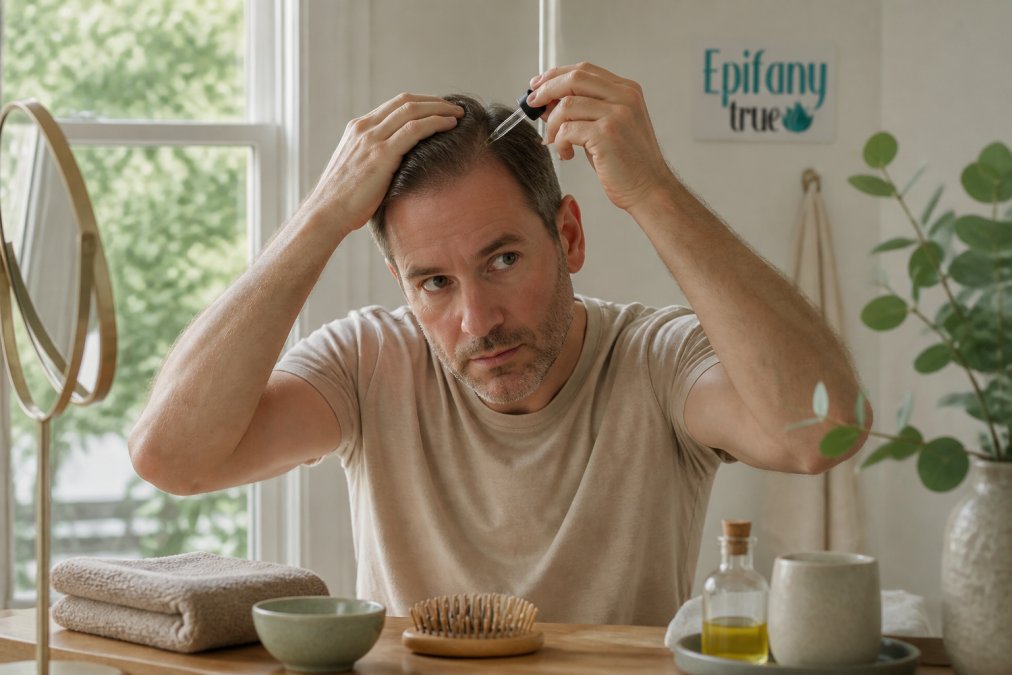
How long should you leave scalp oil on? For a soothing routine, 20 to 30 minutes is enough. Leaving it on overnight is optional and only works if the scalp tolerates it without itching.
Post-Application Washing
Rinse with lukewarm water and a gentle, fragrance-free shampoo, you may need two light lathers to clear the oil. Avoid scrubbing hard, which undoes the calming effect.
Choosing a Soothing Scalp Oil for Hair Loss: What to Look For
The best soothing scalp oil for a sensitive, treatment-stressed scalp is short on ingredients and heavy on gentle, non-comedogenic carriers, cold-pressed oils and calming botanicals, not long lists of fragrance and actives.
Check for these qualities:
- Short ingredient list with recognizable plant oils
- Non-comedogenic carriers like sunflower and jojoba
- Calming botanicals such as chamomile
- No synthetic fragrance or drying alcohols
- Cold-pressed oils that retain their nutrients
| What to Look For | Why It Matters | Skip It If |
|---|---|---|
| Short ingredient list | Fewer triggers for reactive skin | List runs 20+ items |
| Sunflower, jojoba, coconut | Gentle, non-comedogenic moisture | Heavy mineral oil base |
| Chamomile | Traditionally calming for skin | Synthetic fragrance added |
| Cold-pressed oils | Retain natural nutrients | Heavily refined blends |
When to Skip Scalp Oil: Contraindications and Safety
Scalp oil is not right for every scalp, and knowing when to skip it prevents a small problem from getting worse. Several very different conditions look alike on the surface, flaking, itching, redness, but respond in opposite ways to oil.
Conditions Where Oil Helps vs. Where It Hurts
| Condition | Looks Like | Does Oil Help? |
|---|---|---|
| Dry scalp (xerosis) | Fine, white flakes; tight feeling | Yes, barrier-supporting carriers help |
| Seborrheic dermatitis | Greasy yellow scales, often at hairline and eyebrows | No, oil can feed the yeast involved |
| Scalp psoriasis | Thick silvery scales, well-defined plaques | Sometimes, only under dermatologist guidance |
| Fungal infection (tinea capitis) | Patchy hair loss, broken hairs, scaling | No, needs antifungal treatment |
| Contact dermatitis | Redness, itching, burning after a new product | No, stop all new products first |
| Folliculitis | Small pus-filled bumps at hair follicles | No, oil can occlude and worsen it |
Why Seborrheic Dermatitis Is the Big One
Seborrheic dermatitis is the most commonly misidentified scalp condition. It is driven in part by Malassezia, a yeast that lives on most scalps and feeds on sebum and certain oils, particularly oleic-acid-rich oils like olive and coconut. Applying those oils can temporarily soften scales but often worsens the underlying flare over days.
Patch Testing: Do It Properly
Always patch test before a full application. Apply a small amount behind the ear or on the inner forearm, wait 24 to 48 hours, and check for redness, itching, or swelling. Delayed contact dermatitis can take up to 72 hours to appear, so extend the test if you have a history of reactions to plant-based products.
Medical Situations That Require a Clinician First
- Active infection or weeping skin, see a clinician before applying anything
- Sudden, patchy hair loss, this pattern can indicate alopecia areata or a fungal infection, both of which need diagnosis
- Chemotherapy or radiation, check with your care team before starting any new topical product; some ingredients can increase sensitivity or interact with treatment
- Prescription topical treatments (minoxidil, corticosteroids, antifungals), oil applied over or under these can affect absorption; ask your prescriber about timing
- Known allergies to nuts, seeds, or specific botanicals, cross-reactivity is possible with carrier oils
When to Stop and See a Dermatologist
Stop oil use and seek care if you notice: spreading redness, warmth, swelling, pus, pain that worsens, hair loss that accelerates after starting a product, or no improvement after four weeks of gentle care. A dermatologist can distinguish between conditions that look identical in a mirror but require completely different treatment.
Conclusion
A tender, thinning scalp is exhausting to manage, and the wrong product can set recovery back. The right approach is simple: calm the skin, support the barrier, and avoid anything that irritates it further. Epifany True makes gentle, plant-based scalp care for exactly this moment, with soothing oils built on organic sunflower, jojoba, coconut, and chamomile, plus a dedicated formula for men.
Frequently Asked Questions
What is the best oil for scalp hair loss?
There is no single best oil, but the most useful ones calm the scalp while supporting the hair growth cycle. Cold-pressed jojoba, sunflower, and extra virgin coconut oils are lightweight and non-comedogenic, so they moisturize without clogging follicles. A soothing scalp oil built on these carriers, like Epifany True's Scalp Soothing Oil with organic chamomile, is designed to comfort a tender scalp rather than promise regrowth. If you want a growth-focused option, Jamaican black castor oil is traditionally massaged into the scalp to promote blood circulation.
Is oiling your scalp good for hair loss?
It depends on why you are losing hair. Oiling will not reverse genetic or medical hair loss, and Epifany True states plainly that its Scalp Soothing Oil is not a hair growth oil. What oiling does well is reduce dryness, calm irritation, and support the scalp barrier, which matters because a chronically itchy, flaky scalp is a poor environment for follicles. Used with a gentle massage technique, oiling supports blood circulation and nutrient absorption at the follicle level.
Can scalp inflammation cause hair loss?
Yes. Persistent inflammation around the follicle can interrupt the hair growth cycle and push follicles into a resting phase earlier than normal, which shows up as shedding and reduced hair density. Signs include redness, tenderness, itching, and flaking. Calming that inflammation with a soothing scalp oil, a patch test first, and a gentle massage is a reasonable first step, but see a dermatologist if the scalp is painful, oozing, or losing hair in patches.
How often should you apply oil to a thinning scalp?
Two to three times a week suits most people with a dry or tender scalp. Apply a small amount, massage for five minutes, and leave it on for at least 30 minutes, or overnight if your scalp tolerates it. Wash it out with a mild shampoo so residue does not build up and clog follicles. If your scalp is very reactive, start once a week and increase only if your scalp stays comfortable.
Previous article

Next article


